The program develops 9 experiments that are carried out by the 4 universities of the consortium. Additionally, a web platform able to store videos and material related to the experiments during the extension of the programme.
The experiments by institution are described as follows:
Universitat Politècnica de Catalunya (UPC)
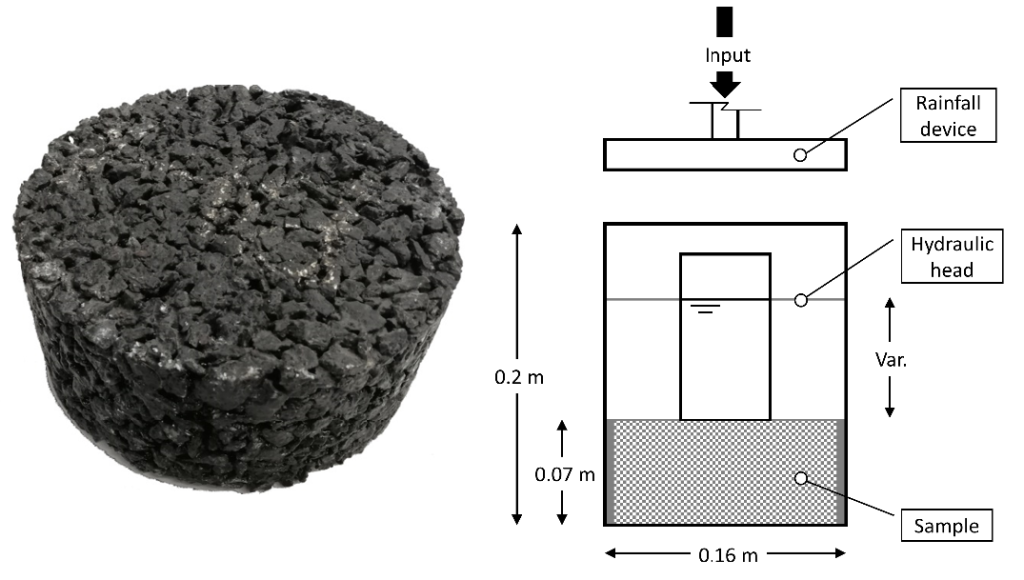
Experiment 1 – Design and Set-up of infiltration measurements for permeable pavement
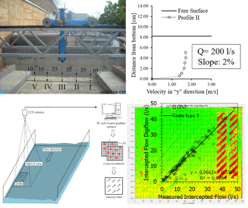
Experiment 2 – Design and Set–up of inlet structure efficiency measurement in urban floods
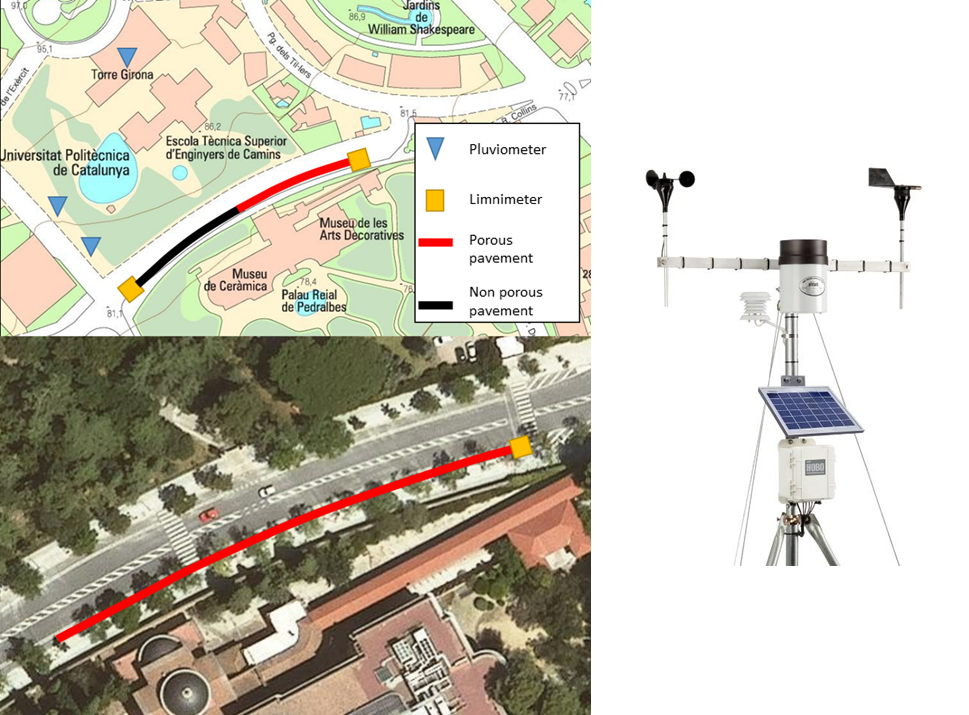
Experiment 3 – Design and Set–up of a catchment located in an urban area of the city of Barcelona
The experimentation part will consist of pouring rainfall with constant intensity over the sample keeping a constant hydraulic head on the surface of the sample. The sample will be placed at the bottom of the cylinder, while a rainfall simulator device supplies water from the upper part under conditions close to reality. The window of the device will allow to observe the water behaviour over the sample and to control the water depth visually
The experiment will consist of analysing the capacity and efficiency of grate inlet under different conditions of discharge, velocity and water depth. This will be carried out in the UPC hydraulic lab using the platform (scale 1:1) adapted under different conditions of slope and discharge
Real case of study of a basin located in an urban area of the city of Barcelona. The experiment will consist of analysing the capacity of the catchment and the surface (porous pavement) to infiltrate water and to delay and decrease the peak discharge.
Politecnhika Warszawska (WUT)
Experiment 1 – Hydraulic conductivity
Experiment 2 – How does a well work?
Experiment 3 – Groundwater flow under the obstacle
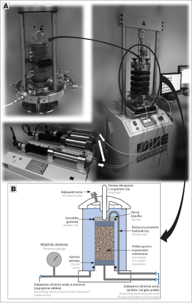
Experiments show methods for hydraulic conductivity analysis, from collecting solid material (soil/rock) specimens to finally determining their value. Exemplary materials will be used to determine hydraulic conductivity values using simple sieve analysis (or gradation test), advanced tests by triaxial apparatus and experiment based on Darcy’s law using a Mariotte’s bottle. Additionally, the experiment which determine the Water Retention Curve for Sand will be conducted.
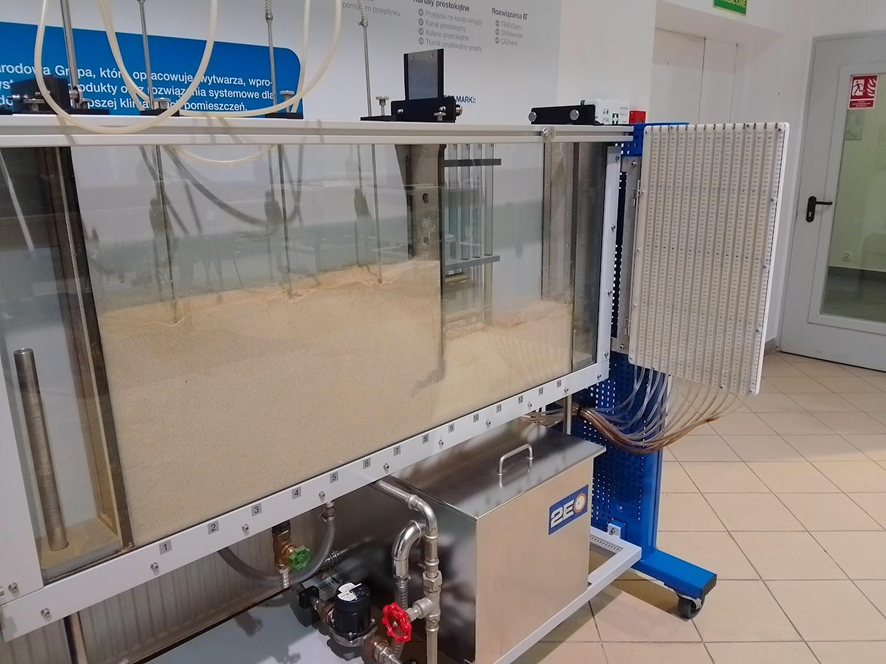
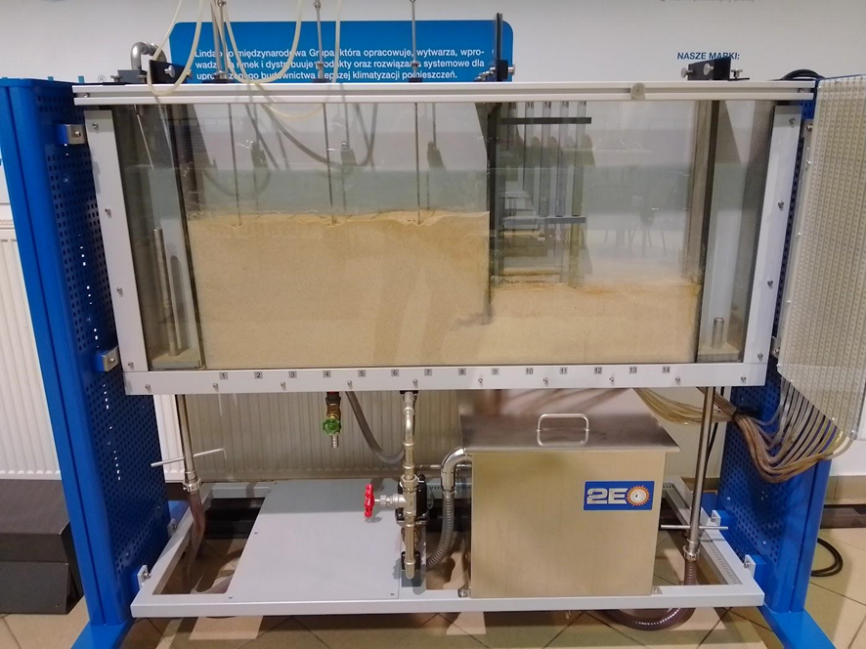
The experiment will consist of water flows to a well at different pumping rates. This experiment will visualize the impact of pumping water from a well on the formation of a depression cone in the aquifer. A station will be prepared where it will be possible to test various values of water intake from the well.
The local flow of groundwater under an obstacle will be presented in the form of an experiment. The model used in experiment 2 (a station consisting of a narrow tank equipped with a number of piezometers for measuring pressure in characteristic cross-sections and a water supply and collection system) can be used to study the flow below the obstacle (figure 9). For this purpose, a sheet pile wall (excavation lining) will be introduced into the model and the given geometry will be recreated (different ground levels on the inflow and outflow sides).
Università della Calabria (UNICAL)
Experiment 1 – Batch experiments on NBS soil substrates to evaluate adsorption isotherms, and potential adsorption capacity on several nutrients
Experiment 2 – Flow experiments on NBS Lab test bed. Evaluation of the nutrient leaching behaviour on a NBS test bed
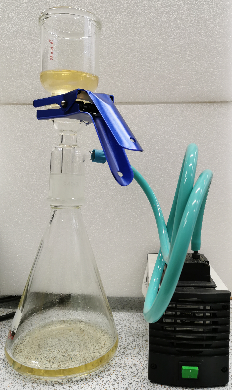
Experiment 3 – Total Suspended Solids assessment on water matrix

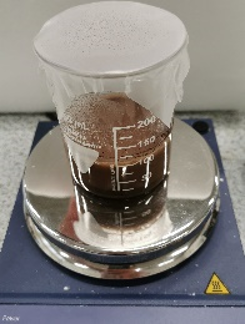
The experiment will consist of batch experiments to evaluate the adsorption isotherms and the potential dissolved nutrient (Nitrogen-Phosphorus) removal efficiency on green wall soil substrate.
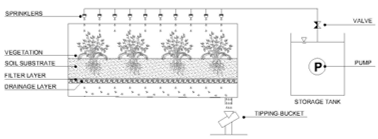
The experiment will consist of water quality performance of a green wall (GW) by spraying several dissolved nutrients on a green wall test bed in real scale (prototype 1:1).
The Total Suspended Solids of water sample are collected by filtration on a special membrane filter and defined gravimetrically after drying of the filter at a temperature of 103-105°C until constant weight is reached.